The Major Chart Patterns — How to Read Any Chart in Ten Seconds
Before you look at signs, before you count aspects, before you place a single planet in a house — look at the shape.
The shape of your chart can be referred to as a planetary pattern, and it tells you the core energy of the whole chart at a glance. It’s the first thing a working astrologer notices when they open a wheel, because it shows you how the person is organized before you learn anything about what they’re organized around.
There are up to ten of these patterns, depending on whose system you follow. The original seven were catalogued by the American astrologer Marc Edmund Jones in the mid-twentieth century. Modern practitioners have extended the list to include a few variants and configurations that behave patternlike in their own right. Together they give you a fast, reliable read on the psychological shape of a life.
Here’s the full map.
The Seven Original Patterns
1. The Bundle
All ten planets sit within a 120° span — roughly a third of the wheel. A tight cluster.
The Bundle chart belongs to someone with a narrow, concentrated focus. Their entire life orients around a specific set of themes, and they can go deep in that territory in a way that people with more spread-out charts simply can’t. The trade-off is that huge sections of life sit unactivated. They’re not missing — they’re just not lit up.
If this is you: you specialize. You’ve probably been told to broaden your horizons, and you’ve probably ignored the advice because broadening doesn’t feel like a gift, it feels like dilution. But don’t fret. It’s the pattern doing what it does.
2. The Bowl
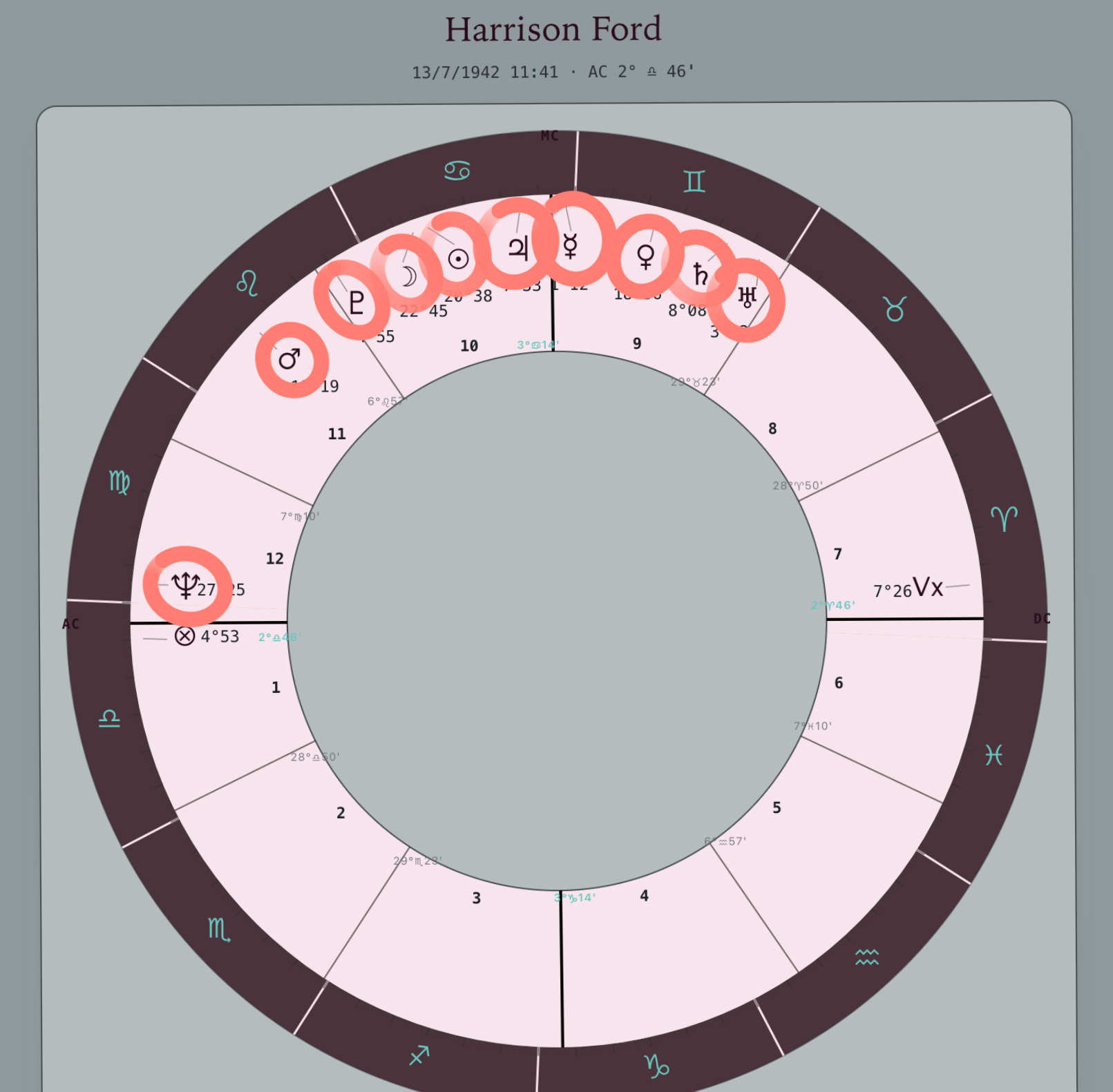
All planets sit in one hemisphere of the chart — one 180° half, with the other half empty.
The Bowl person is self-contained. They carry a sense of completeness in the hemisphere they occupy, and a persistent awareness of what’s missing on the other side. That missing half is what they seek, often through partners, work, or the parts of life they had to build for themselves because nothing in the chart handed it to them.
The hemisphere the planets sit in tells you the flavor. Upper bowl: outward-facing, public, career-oriented, seeking meaning through visibility. Lower bowl: inward-facing, private, seeking meaning through inner life and roots. Eastern (left) bowl: self-directed, autonomous. Western (right) bowl: others-directed, relational.
If this is you: you know which half you live in, and you know exactly what you’ve been reaching for.
3. The Bucket
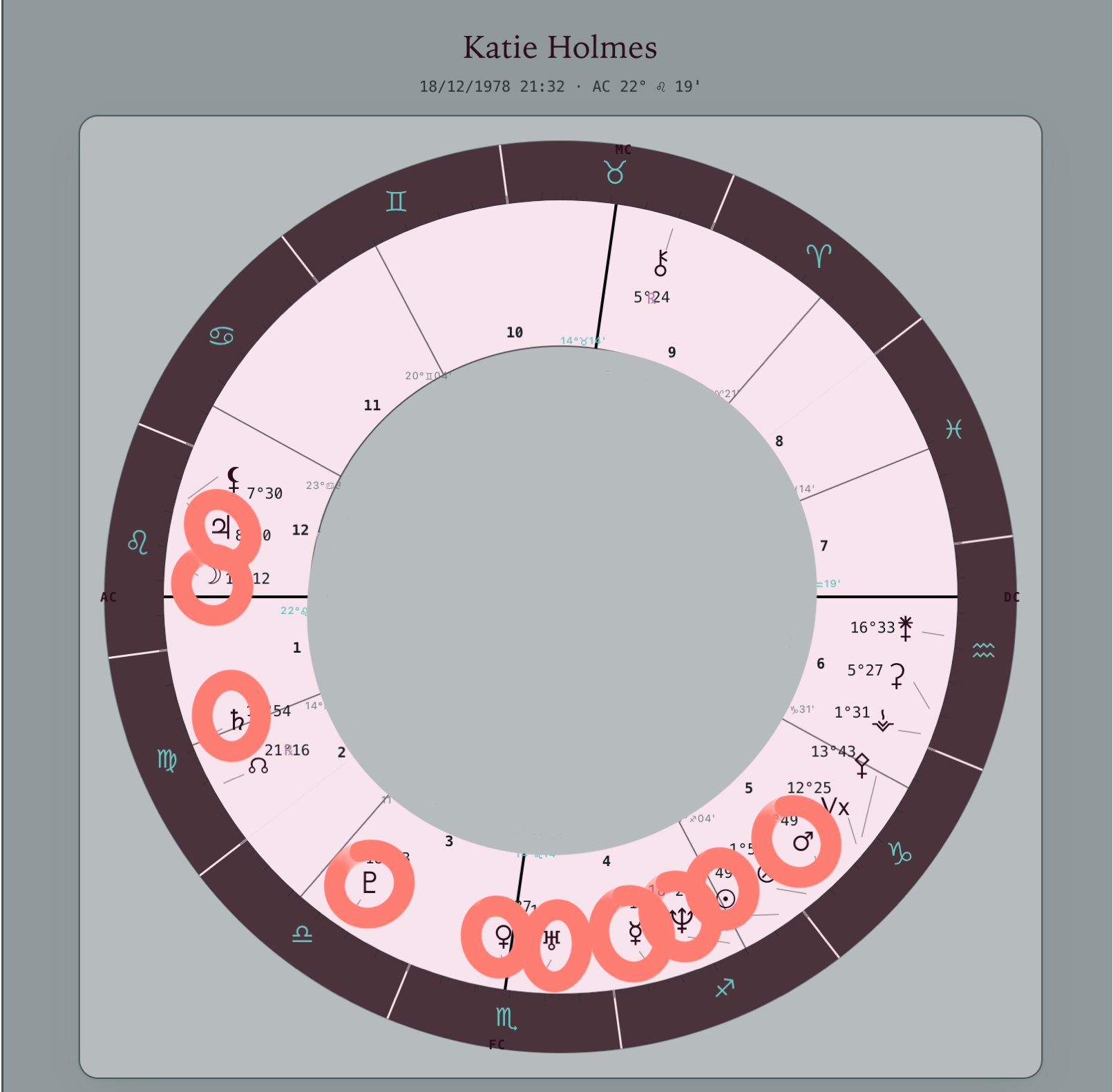
Nine planets form a bowl, and one planet sits alone across the chart. That lone planet is the handle.
The Bucket is a bowl with an outlet. All the concentrated energy of the nine planets funnels through the single planet on the other side. That handle planet is what the person is here to do with everything they’ve accumulated. It runs the show, whether they consciously identify with it or not.
Which planet is the handle matters enormously. A Mars handle drives the whole chart through action. A Saturn handle routes everything through discipline and long-term structure. A Neptune handle sends everything out through art, service, or dissolution.
If this is you: find your handle. That planet is doing more work than you probably realize.
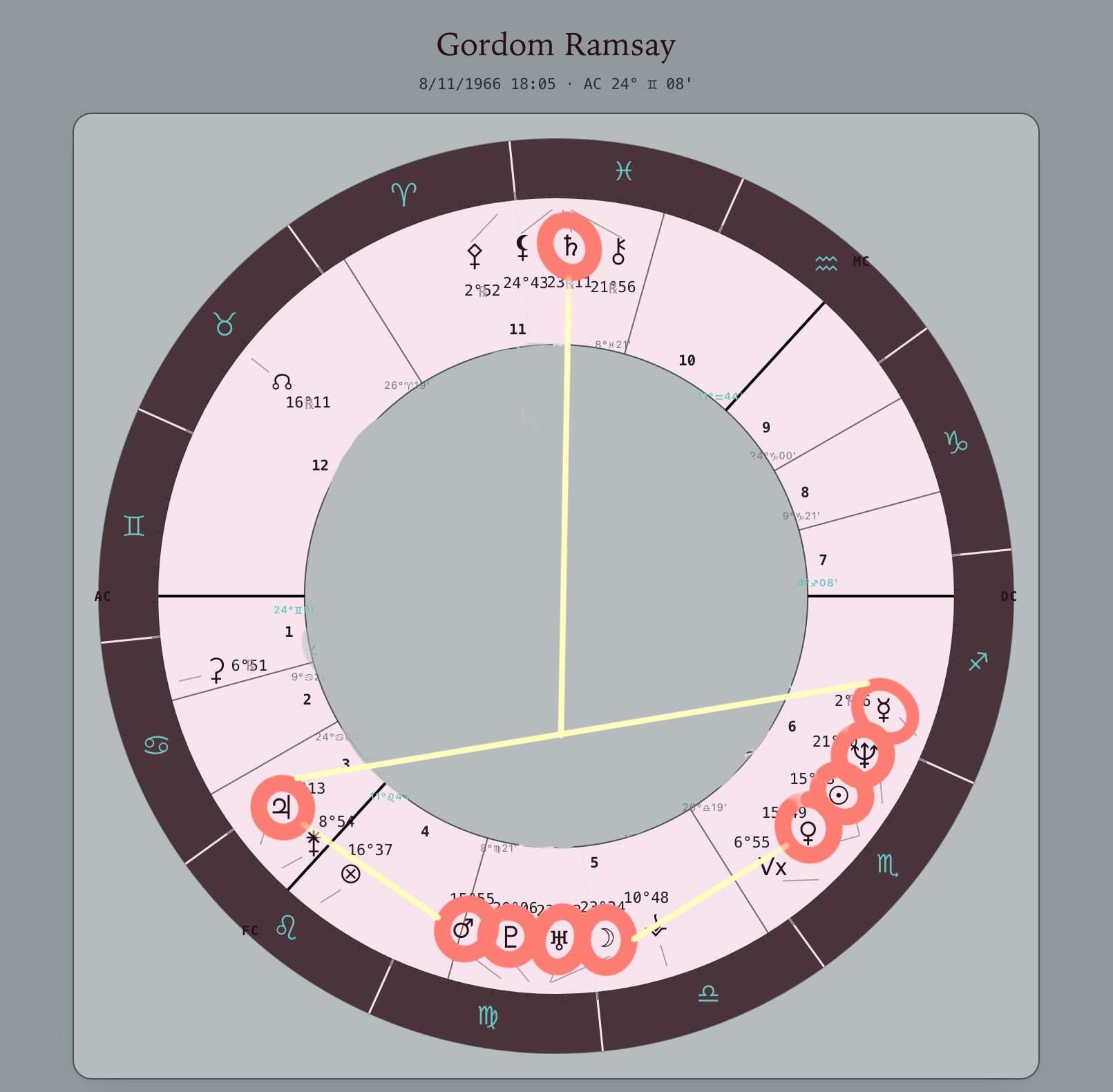
4. The Locomotive
Planets are spread across two-thirds of the chart, with an empty third. No specific handle, but the leading planet (the one that rises first as the wheel turns clockwise, meaning the one immediately clockwise from the empty space) is the driver.
The Locomotive is someone with drive, momentum, and a self-generating engine. They pull themselves through life without needing an external push, and they can generate energy in the empty third of their chart through sheer forward motion.
If this is you: you know how to run. Rest is what you have to learn on purpose.
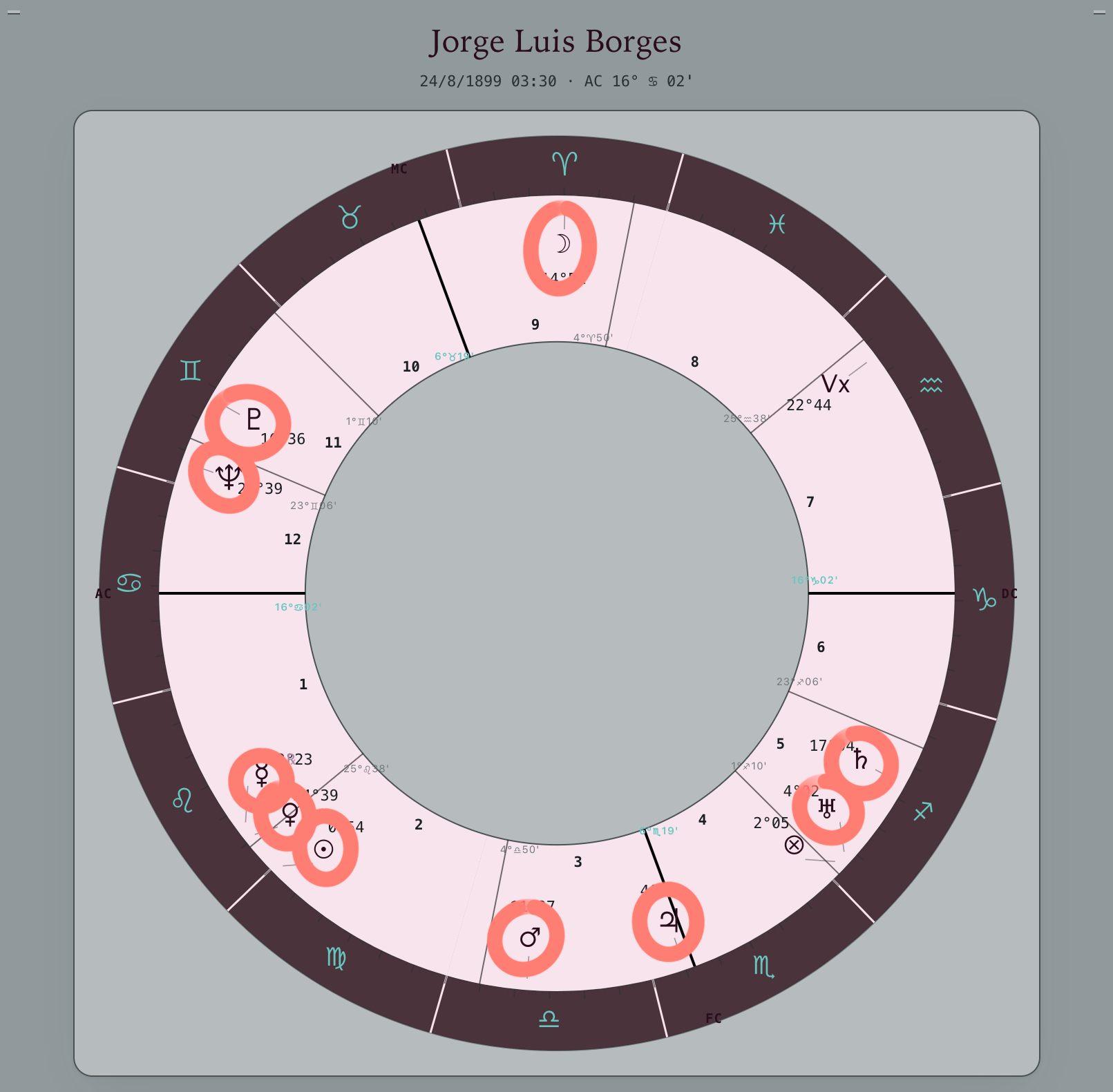
5. The Bowl (Half-Chart) — sometimes overlaps
Some systems distinguish the strict 180° Bowl from a slightly looser hemisphere emphasis. The reading is essentially the same. If your planets sit within a hemisphere with maybe one or two just crossing the edge, treat it as a Bowl for interpretive purposes.
6. The See-Saw
Planets form two clear groups sitting across from each other, with two empty spaces between them.
The See-Saw person lives in negotiation. Two poles of experience pull at each other constantly, and the person becomes fluent in holding tension between opposites — between self and other, between inner and outer, between what they need and what they owe. They rarely feel settled in one camp because their chart doesn’t let them.
At their best, See-Saw people are natural mediators, diplomats, and translators between opposing worlds. At their worst, they’re perpetually torn.
If this is you: you’ve probably tried to choose a side. You can’t. The pattern is asking you to hold both.
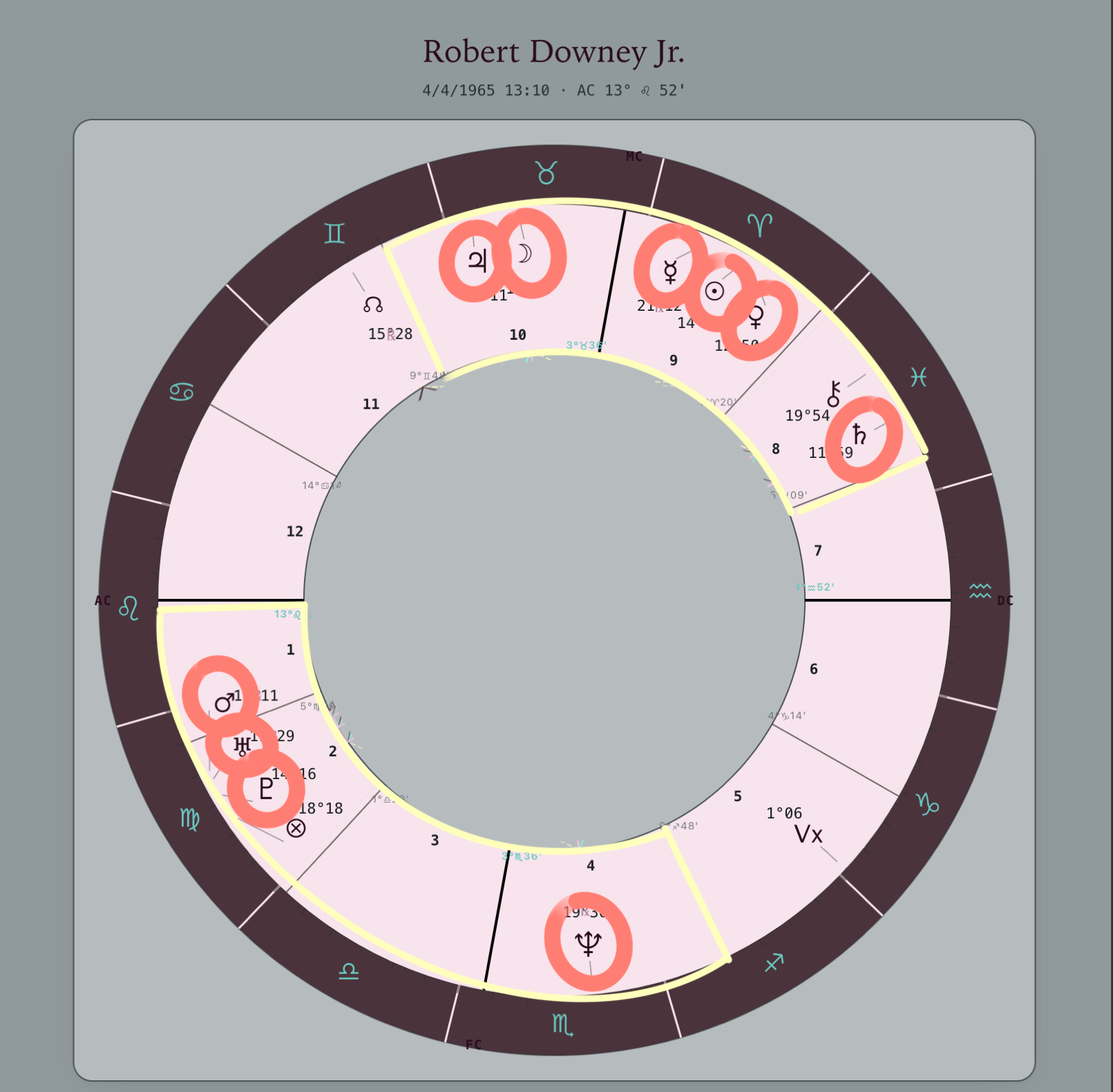
7. The Splash
Planets spread evenly around the wheel. No obvious concentration.
The Splash person has interests everywhere. They’re natural generalists — curious across many fields, unable to specialize easily, sometimes accused of being scattered. Their gift is versatility. Their challenge is that specialization takes real effort because their chart wasn’t built for it.
If this is you: you’ve probably been told to focus. The pattern is telling you that focus is your growth edge, not your default setting. Both are valid.
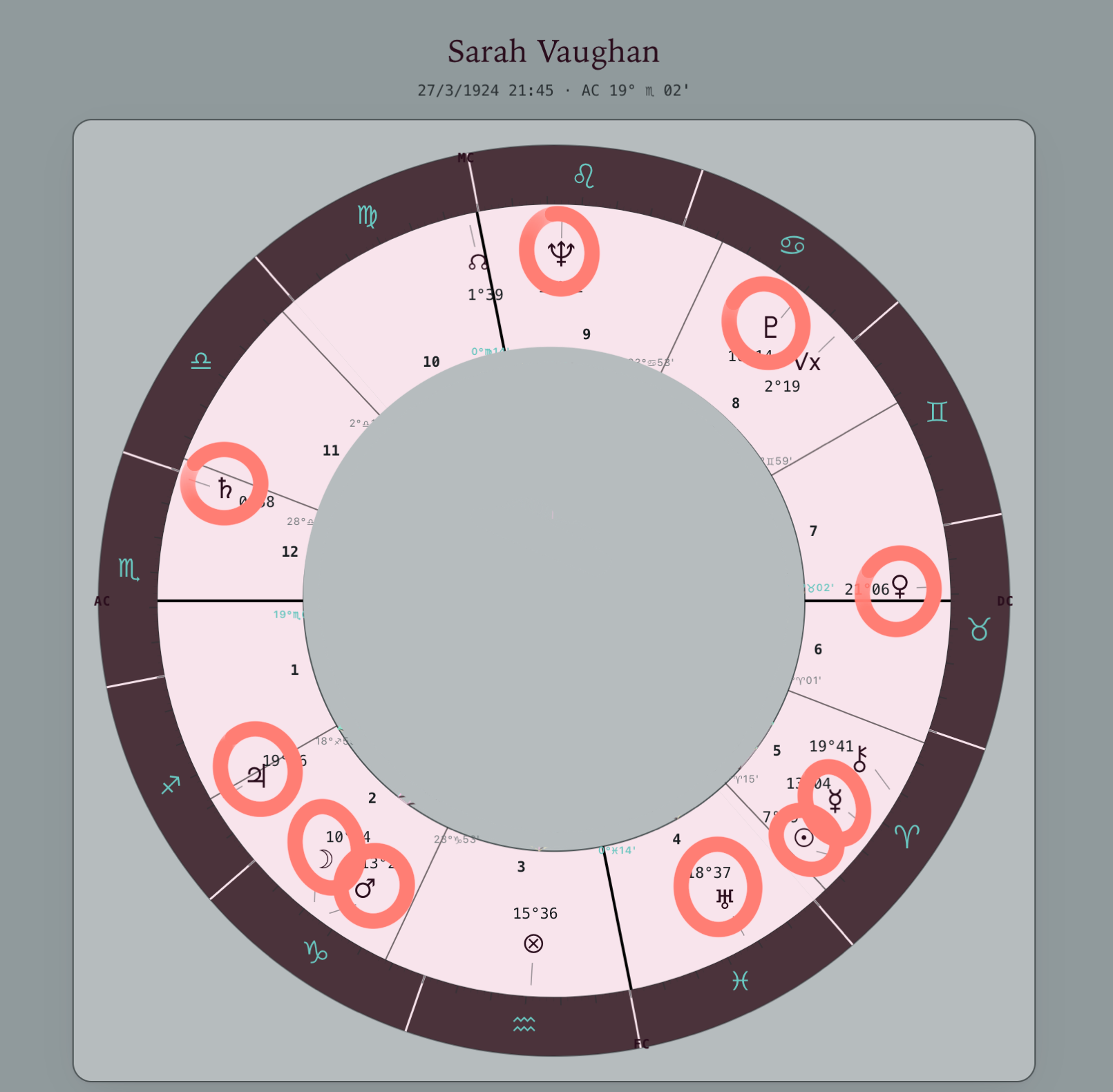
8. The Splay
Planets form three or four distinct clusters, unevenly distributed, without the symmetry of a See-Saw.
The Splay is the most individual of the patterns. There’s no obvious center of gravity. The person moves through life following their own internal logic, hard to categorize and often hard to predict. Splay people tend to have unusual life paths precisely because their chart doesn’t push them toward a standard shape.
If this is you: you’ve probably given up trying to explain yourself with normal categories. Good.
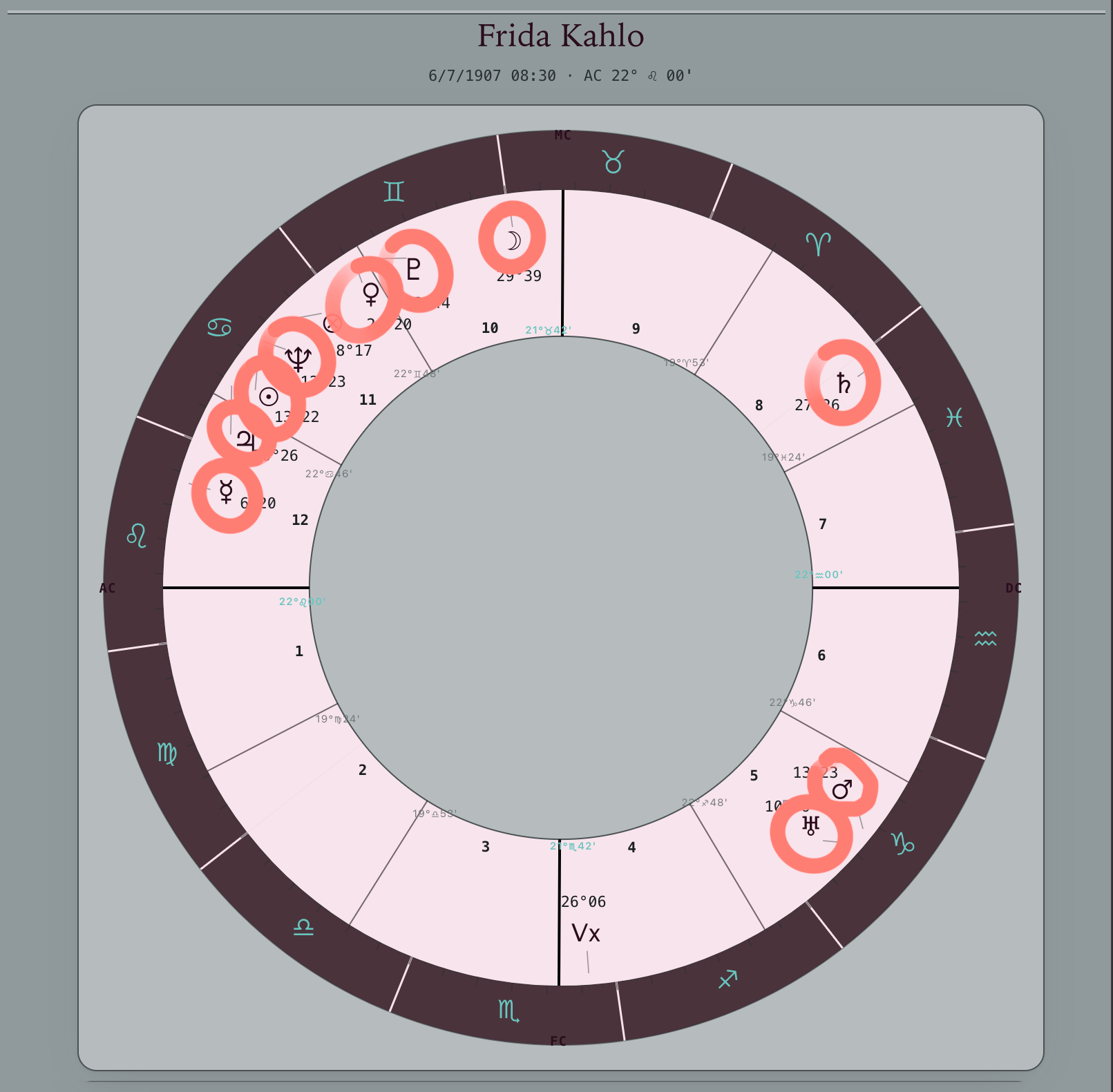
The Extended Patterns
Some modern astrologers add these to the standard seven.
9. The Fan
A variant of the Bucket. Nine planets form a tight bundle, and one planet sits opposite as a handle. The difference between a Fan and a Bucket is the tightness of the main group — Fan has a very concentrated cluster, Bucket has a looser hemisphere.
The reading is similar to the Bucket, but more intense. The handle carries an even greater load because the main body of the chart is so concentrated. Whatever that lone planet is, it’s basically the entire outlet for a very focused psyche.
10. The Grand
or Cradle Configurations
Some practitioners include the Grand Trine (three planets in a triangle across the same element) or the Cradle (a soft, half-hexagonal support structure) as pattern-level features when they dominate a chart. These are technically aspect configurations rather than distributional patterns, but when a chart is organized around one of them, the effect is patternlike — the person’s whole psychology tends to move through that shape.
The Fast Hemisphere Read
Once you’ve identified the pattern, check the hemispheres. This adds another layer in about five seconds.
Above the horizon — planets sit in houses 7 through 12. This is the public half of the chart. Career, visibility, social role, the outer world. Someone with a strong upper hemisphere lives their life outward.
Below the horizon — planets sit in houses 1 through 6. This is the private half. Inner life, family, personal development, the quiet work. A strong lower hemisphere means someone who builds from the inside out.
Eastern (left) hemisphere — planets sit in houses 10 through 3. This is the self-directed half. Autonomy, initiation, the person driving their own life.
Western (right) hemisphere — planets sit in houses 4 through 9. This is the others-directed half. Relationships, collaboration, being shaped by the people around you.
Most charts lean one way or another. A chart with a strong upper-western emphasis, for example, describes someone whose public life is deeply shaped by relationships — a natural collaborator with a visible role.
Why This Matters
The reason patterns are worth learning is that they orient you before you drown in detail.
Modern astrology is complicated. There are twelve signs, twelve houses, ten planets, dozens of aspects, asteroids, nodes, house systems, and enough interpretive layers to keep anyone busy for years. It’s easy to get lost. Patterns pull the camera back and show you the shape of the whole thing.
They also tell you something the individual placements can’t. Two people with identical Sun signs and similar Moon placements can have completely different lives if one is a Bundle and the other is a Splash. The pattern is doing structural work that no single placement can override.
And once you know your own pattern, you stop being surprised by certain themes. If you’re a Bowl, the empty half will keep calling. If you’re a Bucket, the handle will keep asserting itself. If you’re a See-Saw, the pull between poles won’t stop, no matter how much you wish it would. These aren’t random tendencies — they’re built into the shape of your chart.
How to Find Yours
Pull up your birth chart. Any free chart calculator will do — Astro.com, Astro-Seek, TimePassages.
Look at the wheel. Ignore the signs and aspects for a moment. Just look at where the planets sit.
- Are they clustered in one third of the wheel? Bundle.
- One half? Bowl.
- A bowl with one planet alone on the far side? Bucket.
- Spread across two-thirds with an empty third? Locomotive.
- Two clear groups facing off? See-Saw.
- Spread more or less evenly all the way around? Splash.
- A few uneven clusters without symmetry? Splay.
Then check the hemispheres. Which half of the chart is heaviest? Upper or lower, left or right? That’s your bent.
That’s it. In under a minute you’ve read the core energy of the chart. Everything else you learn about signs, houses, and aspects sits on top of that structural foundation.
If you want to map your whole chart — pattern, planets, houses, aspects, and the way they all talk to each other — my guided workbook Know Thyself walks you through every piece.
And if you’d rather have someone read it for you, book a session and we’ll go through your pattern and what it’s asking of you.
Cosmic notes, straight to your inbox.
Monthly-ish. Never spammy. Astrology insight, upcoming transits, and behind-the-scenes.